
South Africa -
Time to Shine
posted - November 22, 2011
By Daenna Van Mulligen
sister site to
WineDiva.ca

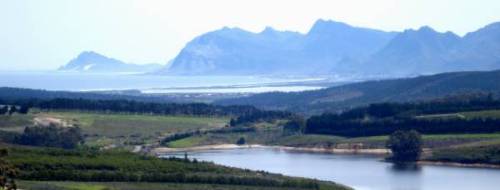
Vines & indigenous fynbos with a typical Western Cape
backdrop
Three years ago, after returning
from an eye-opening trip to South Africa, I wrote about my experiences in this
stunning country.
In the years following I found myself educating the public about the charms of
South Africa and her outstanding wines - wines of value and quality. I wrote
about South Africa for the BCLiquor Stores Magazine,
Taste in
the summer of 2010, and for
Vines Magazine in the fall of 2009. (Both of which I contribute
regularly to).
I also presented seminars to consumers and trade during the 2009 and 2010
Cornucopia -
Whistler's Celebration of Food & Wine.
My point is, nothing has changed or altered my perception of South Africa, if
anything it was reinforced after I attended the two-day, Cape Wine Europe
tasting in London, England recently.

And yet still, South Africa is rarely at the top of our wine shopping lists,
unless it's for the obvious bargain wines. The reason is not due to quality
(this I can assure you of) but rather lack of availability.
But that may be changing - it may finally be time for South Africa to shine here
as well.
(right: Capetown and Table Mountain)
Because of the job I do, I am surrounded daily by people in the wine industry,
agents, winemakers and writers.
It's a good thing and a bad thing.
Your peers can lead your concentration toward obscure yeast strains, ph levels
and clonal selections while presenting arguments on the wine industry as a
whole.
There can be a lot of back-patting and insular chatter.
At the same time, their lack of basic consumer understanding can be detrimental.

What do consumers want?
My thoughts: a damn tasty bottle of wine at an affordable price.
Affordable is relative I understand, but I can also tell you that a wine drinker
who makes a six figure salary will be just as pleased with a delicious $16
bottle of wine as someone who makes far less.
This is what makes South Africa special. And more.
Now, as wine trends go there's been a fairly obvious shift in drinking styles.
If you follow the industry or not, you will have noticed the huge swing in sales
of Australian Shiraz to Argentine Malbec in the past couple of years. If you
haven't really noticed, just take a peek at what your friends are drinking, what
is widely available on wine lists and what's in your own shopping cart.
Part of that is the price of Argentine Malbec and part of that is a palate
change to a less obvious sweet fruit-bomb red style to something more succulent,
savoury and almost chewy as many Malbecs tend toward.
But
there is something else afoot, the wine industry's (wine writers, winemakers,
connoisseurs) push for elegance and balance in wine.
To simplify this statement - wines which have more character, are slightly
leaner, slightly lower alcohol and higher acidity.
Wines that more typically reflect an "old world" style.
(above right: sunset at Hermanus. Below: Cape Wine
Europe tasting, London England)
What are "old world" wines?
They are wines from Europe.
"New
world" wines are from everywhere else - yes even South Africa, which has
been making wine for more than 350 years.
If you have heard these terms before then you might realize, "old world"
often means insipid and lacking fruit (a glass to serve with a meal), and "new
world" a potent, lush and fruity mouth-filling wine (a glass to serve as a
meal).
My analogy is the extreme of course (and not written in stone), but it's also
been the best method I have found to describe, "old world" and "new
world" when I talk to "new world" drinking consumers.
This is also why I truly believe it is South Africa's time to shine.
The sheer beauty of South Africa's wines are that they represent "old
world" and "new world". They are truly the best of both
worlds...offering ripe fruit, bright acidity and finesse.
Wines from South Africa are chic, they are balanced, satisfying, consistently
tasty and offer good value - at all price points.
But if I implore you to try the wines of South Africa, I also need to provide
you with options.
Here are some South African wines I have tasted in the past year, most
are readily available...
Link to wine reviews
here
But, for an
amazing array of truly special wines from South Africa, which have just arrived
on our shores, try Marquis Wine Cellars
shop here
My recommendations if you happen to be shopping at
Marquis Wines...
Backsberg Wine Estate from Paarl.
One of only a handful of carbon neutral wineries in the world, the Backsberg
Estate employs organic vineyard practices and has a positive focus on
sustainability and conservation of the natural habitat and plant life called
fynbos.
But the wines speak for themselves, the Backsberg Hillside Viognier at
$23 is delicious, exotic and rich with a lengthy finish.
The 2005 Backsberg Klein Babylonstoren blend
of Cabernet & Merlot is a steal at $22. It is dense,
plummy and laden with black berries, chocolate
and espresso.
The
Backsberg 2007 Pumphouse Shiraz $22
is outstanding with its "old world/new world" style,
its elegance and brightness, spice and concentrated
fruit followed by a long peppery finish.
($17.55 LCBO)
Finally the Backsberg Family Reserve Red will have you wondering why you
need to buy Bordeaux when
for $35 you can have a chic complex wine
(Cabernet, Merlot, Shiraz, Malbec & Cabernet Franc)
with such finesse and structure.
Springfontein Pinotage Terroir Selection, 2007 $26 is the type of
Pinotage people need to experience. It has fruit and a savoury character which
makes it perfect meat-based dishes.
Edgebaston 2010 'The Pepper Pot' $23 it's a cute name for quite a serious
wine - it is succulent, peppery and dense with a supple weight.
(Syrah, Mourvedre, Merlot)

Edgebaston 2010 'The Honey Pot' $23 blends Semillon, Sauvignon Blanc and
a splash of Viognier is peachy, floral and yes honeyed with bright acidity and a
nicely weighted palate.
Other consistent and recommended producers you may see on
shelves in your area. My choices are based on recent tastings at Cape Wine
Europe in London England.
Cabernet & Cabernet Blends - Icon wines, cellar worthy
De
Toren Fusion 2007
Warwick Trilogy 2007, Cabernet Franc 2008
Boekenhoutskloof Cabernet Sauvignon 2008
Meerlust Rubicon 2007
Vilafonte 'series c'
Rustenberg Peter Barlow 2005
Kanonkop Paul Sauer
Klein Constantia 2008
Klein Zalze Barrel Matured Cabernet 2008
Le Riche Reserve 2008
Meerlust 2009
Stark-Conde Three Pines Jonershoek 2008
Thelema 2008
Syrah/Shiraz
Mont Destin 2007
Klein Zalze Barrel Matured Reserve Shiraz 2009
Boekenhoutskloof Syrah 2009
Saxenburg Private Collection 2006 (available in limited
amounts in BC)
Pinot Noir
Newton Johnson Domaine 2010
Newton Johnson 2009
Bouchard Findlayson Galpin Peak 2010/2009
Radford Dale Freedom 2010
Winery of Good Hope Reserve 2010
Oak Valley 2009
Pinotage
Mellasat White Pinotage 2010 (the only white
Pinotage in existence)
Lyngrove
2009
Diemersdal 2010
Rijk's Private Cellar 2007
Spier Private Collection 2008
Wellington La Cave 2009
Kanonkop 2008
Chardonnay
Bouchard Findlayson Missionvale 2009
Bouchard Findlayson Overberg 2010
Bouchard Findlayson 'Crocodile's Lair' 2009
Creation Reserve 2009
Sumaridge
2009
Paul Cluver 2009
Sauvignon Blanc
Graham Beck Pheasant's Run 2011
Hermanuspietersfontein No 5, 2010
Black Oystercatcher 2010
De Grendel Koetshuis 2011
Circumstance 2011
Sauvignon.com 2011
Chenin Blanc
Swartland 2010
Cederberg 2011
Villiera 2011
Old Vines 2011
Rijk's
Reserve Barrel Fermented Chenin Blanc 2007
Stellenrust 45 Barrel Fermented Chenin Blanc, 2009
DeMorgenzon Reserve 2009
Radford Dale Renaissance 2010
Easy-to-find, all around solid producers
The Winery of Good Hope
Boekenhoutskloof (Wolftrap, Porcupine Ridge)
KWV
Nederburg
Glen Carlou
Cederberg
Fairview
Graham Beck
Bellingham
Ken Forrester
Saxenburg
What I wrote in 2008
about South Africa
South Africa -
In praise and awe
Posted - October 2 2008
By Daenna Van Mulligen
A
recent visit to South Africa has fed me, not only with great wine but with a new
understanding of a country of stunning beauty, passionate people, warmth and a
strong desire to welcome the world. It’s a new country to those of us who talk
on the grape vine yet it was witness to the birth of civilization. Traveling
through South Africa affected me on a visceral level unlike almost anywhere else
I have traveled.
The geography is rough and powerful, rocky and sweeping and stretches as far as
the eye can see. Unlike our Rocky Mountains which seem to strike the sky with
enthusiastic authority the mountains in South Africa provide a prehistoric
memorial. You can sense their watchfulness in the way a grandparent watches a
grandchild – with the lenient eye of one who has seen so very much.
Ironic too, that a wine region which turns 350 years old in 2009 should be deemed
new world, yet it is, and with that South Africa fights the same battle all new
world wine producing countries face – making consumers understand its
uniqueness, its regionality and its strengths. Of course South Africa has faced
other serious problems that other countries have not. But with democracy now
fourteen years in, great strides have been made and the country is looking
forward with eager eyes fully open. Change does not happen overnight – you have
to crawl before you walk but investment in the country is up, and infrastructure
for the 2010 World Cup is being developed with gusto. Money brings strength to a
country in the form of jobs, social assistance and the freedom to welcome the
world with pride.
The wines of South Africa are good – good to fantastic. The much maligned
Pinotage has come a long way from the tarry, rubbery and bitter inky juice most
of us have sampled. This South African developed cross of Cinsault x Pinot Noir
has a youthful history yet it is wholly South African. Invented by Professor
Abraham Izak Perold in the 1925 the first Pinotage wine was made in 1941.
Although Perold spent much of his career at (the well recognized) KWV, it was
the wineries of Kanonkop and Bellevue who were the first to produce it (they
still do) but it wasn’t until 1959 when the first commercial Pinotage was
bottled and sold by Lanzerac.
continue
reading...