A New Riesling Generation
Part
3
The Mosel
Posted August 13 2008
By Daenna Van
Mulligen
You’ll
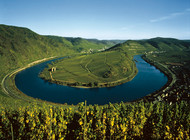
recognize as you enter the Mosel River Valley that this is a beautiful, special
place. Your breath will catch and perhaps you’ll hear strains of Wagner dancing
in your head. Lush vineyards blanket the sharply rising slopes on either side of
the river as you drive the narrow meandering highway that runs about 180 km
between Koblenz and Trier. Along the way, the picturesque villages of Cochem, Piesport,
Zell and Bernkastel-Kues as well as the village of Mulheim an der Mosel - a
short four kilometer bike ride away from Berkastel~Kues - where I stayed at the
charming Weinromantikhotel
Reichtershof.
I suggest you visit this one with your romantic partner - as the name suggests.
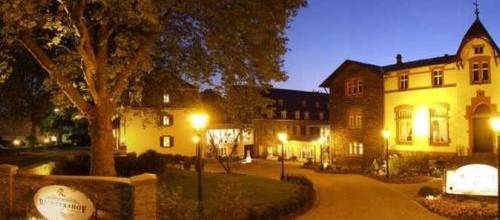
Weinromantikhotel
in Mulheim an der Mosel
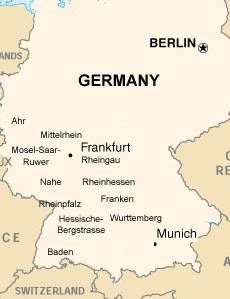
Mosel~Saar~Ruwer is the name
of the region that is comprised of the three sub-regions of Mosel, Saar and
Ruwer - a combined 9300 hectares of vineyards.
These vineyards are often so steep that the manual labour time to tend them is
more than double that of other regions in Germany – and until you’ve walked high
up (even all-terrain vehicles cannot maneuver up into many vineyards)
to the uppermost planted vines, its hard to imagine. In my case vertigo took
hold – going up was fine, going down, another matter.
And, almost unbelievably, there are vineyards in the Mittel (middle) Mosel which
haven’t been fallow for over 1800 years - the slate soil in this region
regenerates itself – it heats easily and retains that heat. Much needed heat
which assists in achieving the ripeness grapes need to become the incomparable
Mosel wines. Although it’s considered cool-climate, the growing season is
lengthy in this protected slice of world – its terroir responsible for the
fruity, low alcohol, light-body and bright acidity found in its wines.
The Mosel is not only the oldest wine-growing region in Germany but is the
densest Riesling planted place on earth – producing its treasures for such
world renowned producers as; Egon-Müller~Scharzhof, S.A Prüm, Joh Jos. Prüm, Dr.
Loosen, Reichsgraf von Kesselstatt...
It’s impossible not to adore, wax and gush about the Mosel region. What’s not to
love? It’s all stunning - the geography, the quaint villages and the Riesling –
of course.
Selbach-Oster
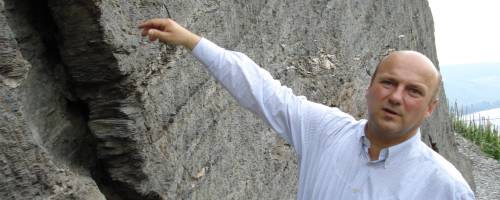
Johannes
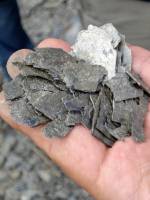
Selbach pointing out the quartz, iron ore and slate in the rock face overlooking
his Zeltingen vineyard far above the Mosel River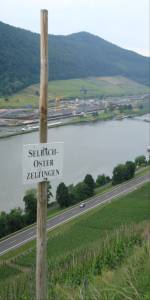
Johannes Selbach is
passionate about the Mosel.
He’s passionate about the slate, the old, ungrafted Riesling vines and the Mosel
soil which has run in the winemaking Selbach’s veins since 1661.
The company actually falls into three parts which have developed over the last
century.
First - Weingut Selbach-Oster with 20 hectares of south facing slopes spread
over some of the best vineyards in the Mittelmosel. Those being:
Wehlen
(Sonnenuhr vineyard,) Zeltingen (Sonnenhur, Schlossberg Himmelreich),
Graacher (Domprobst, Himmelreich) and Bernkastel (Badstube).
Second - J&H Selbach WeinKellererei the négociant
and lastly J&H Selbach Weinkommission a brokerage agency
that exports a selection of German wines to markets around the world.
On a recent visit to Selbach~Oster in the town of Zeltingen
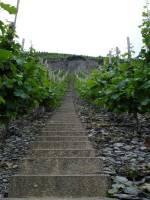
I tasted the premium wines of Weingut Selbach~Oster – a
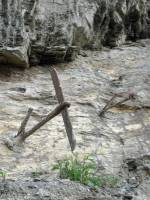
welcome diversion after scaling Johannes’ mountainside vineyards, tasting the slate and observing the spikes
(ancient and modern) driven deep into high, mineral-rich rock faces to prevent
fractures.
There’s no machinery used in these vineyards, only human power.
Which makes it understandable why more than 50% of the Selbach vineyards are low
fruit-bearing, old, un-grafted vines – replanting is extremely labour intensive
on those angles.
right - pictures in a Selbach~Oster vineyard
Tasting
Notes for Selbach~Oster:
Zeltinger Himmelreich Riesling Kabinett Trocken, 2007 – Slate, citrus -
lemon oil and zest, wildflower honey and crisp apple with beautiful acidity,
clean mountain stream flavoured minerality, almost steely, with a zesty,
mouth-watering finish.
Zeltinger Schlossberg Riesling Spätlese Trocken, 2007 - Juicy apples, slate
and lime aromas that reappear on the palate – smooth, elegant with loads of
slate flavours andlingering
crisp fruit with mouth-watering acidity. Delicious!
Zeltinger Himmelreich Riesling Kabinett Halbtocken, 2007 – Snappy – crisp
apple, lemon drops and candied citrus peel aromas with wildflowers and slate.
Richer texture on the palate than the trocken wines with a brush of sweetness, a
hint of smoke and slate with snappy acidity to clean and lovely lingering
finish.
(The 2004 is available in SAQ stores for $15.90)
*Zeltinger Schlossberg Riesling Auslese Feinherb, 2005 – The feinherb
(see decriptors here) has more golden glints to its colour as well as a couple
of years to its age. The aromas are seductive – honeyed and rich with tropical
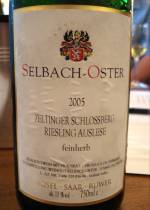 notes
(this wine had a ‘stuck ferment’ and fermented for a wild 9 months). The palate
is just as rich in flavour with creamed honey, wildflowers and wild herbs,
slate, marzipan and grapefruit pith, it has heat and spice, its stunning and
confounding, drawing you back to it again and again to try to figure out its
puzzle.
notes
(this wine had a ‘stuck ferment’ and fermented for a wild 9 months). The palate
is just as rich in flavour with creamed honey, wildflowers and wild herbs,
slate, marzipan and grapefruit pith, it has heat and spice, its stunning and
confounding, drawing you back to it again and again to try to figure out its
puzzle.
What
is, Trocken Feinherb, Kabinett and Auslese? Click here...
Zeltinger
Schlossberg Riesling Kabinett, 2007
– Luminous ripe peachy and stone fruit aromas, honey, minerals and lemon drops.
The aromas reappear on the palate – its smooth and rich in texture, off-dry with
lively acidity – the finish almost sparkles its so clean and fresh and draws a
spritz of zest as it lingers.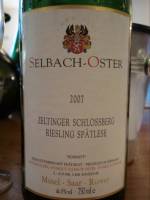
Lip-smacking. Johannes suggests it will still be good in
20 years – I agree.
($32.99 BCLDB, the 2004 is $23.75 in SAQ stores)
Zeltinger
Schlossberg Riesling Spätlese, 2007- Bright apple and apple peel, snappy
lemon- oil and candied rind, herbal hints. The texture is creamy, it’s sweet but
clean with ripe, juicy apples and honey flavours and a zippy, fresh finish.
Lovely.
($38.99 BCLDB, the 2005 is $26.20 in SAQ stores)
Zeltinger Sonnenuhr Riesling Auslese, 2006 – Made from 50+ year old vines
this Auslese is more of a Beerenauslese in style (2006 was the best year since
1976 for botrytis – aka noble rot). Aromas are honey and slate and white
grapefruit leaning toward the more floral pomelo. Slick – almost glycerine on
the palate with tropical hints, lemon balm and candied citrus peel, sweet almost
vanilla-ish spice and a clean, lingering finish. A stunning wine that will
cellar for decades is you have the patience. ($27.99 375ml BCLDB, the 2005 is
$38.50 in SAQ stores)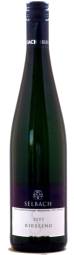
And new
J.H Selbach ‘S’ Riesling, 2007 – Just arrived a new product (with
screw-cap) from J&H Selbach I was excited to be one of the first to taste this
well-priced offering - pale straw in colour with clean, crisp aromas featuring
lemon, white peach and white grapefruit, slate with a hint of smoke, warm honey
and undertones of lemony herbs. The palate kicks off with snappy, zesty acidity,
a pop of sweetness rolls in mid-palate and the finish is mouth-watering with a
bit of grapefruit pith.
Clean, off-dry and very refreshing and what a great
linger.
Yum!
(A good value at
$17.75 BCLDB)
Selbach wines are available across Canada, vintage, price and offerings may
vary.
For more information on Selbach~Oster -
click here
Dr. Pauly~Bergweiler
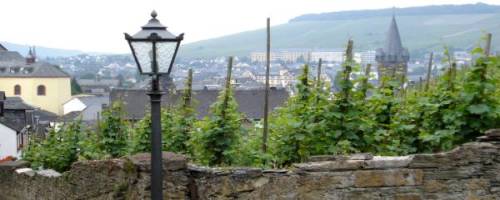
View over
Bernkastel~Kues and the Bernkastel Vineyards
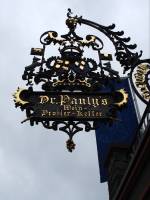 In
the quaint, historical center of Berkastel~Keus is where we found Weingut
Pauly~Bergweiler after an idyllic, meandering bike ride along the Mosel from our
inn, in nearby Mulheim.
In
the quaint, historical center of Berkastel~Keus is where we found Weingut
Pauly~Bergweiler after an idyllic, meandering bike ride along the Mosel from our
inn, in nearby Mulheim.
Owner, Dr. Peter Pauly worked in his family wine business before taking over in
1959 and as of 2006 his son Stephan continues the tradition as managing
director. It may, (or may not) surprise you that the Pauly’s, the Loosen’s and
the Prüm’s are all related (and funny how they all make good wine…).
The Dr. Pauly~Bergweiler grapes come from less than 20 hectares spread
throughout nearby vineyards which include: Bernkastel (Badstube,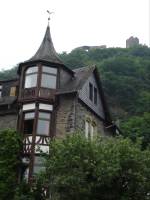 Doctor am Mountain [1.8 hectares that is their best site of the 68 hectares of
Badstube], Schlossberg, Lay and Bratenhöfchen), Graach (Himmelreich,
Domprobst), Wehlen (Sundial, Klosterberg), Brauneberg (Juffer,
Juffer Sonnenuhr) Zeltingen (Himmelreich) and vineyards in Erden and
Ürzig.
Doctor am Mountain [1.8 hectares that is their best site of the 68 hectares of
Badstube], Schlossberg, Lay and Bratenhöfchen), Graach (Himmelreich,
Domprobst), Wehlen (Sundial, Klosterberg), Brauneberg (Juffer,
Juffer Sonnenuhr) Zeltingen (Himmelreich) and vineyards in Erden and
Ürzig.
The bottle labels are old-school German depicting the village, the weingut,
cellar door tasting room and caves - riverfront in Bernkastel~Kues. The
buildings joined through arched entranceways, classic wooden beams and eclectic
décor. If you visit, make sure to utilize the tasting bar – where any bottle
that is available will be opened for tastings – and you can purchase some great
back vintages for very, very reasonable prices!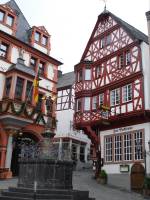
Tasting Notes from Dr.
Pauly~Bergweiler:
Ürziger Würzgarten Riesling
Trocken, 2007 –
Vivid orange peel and lemon meringue, honey and fruit blossom aromas. Bright on
the palate, fresh and softly-rounded on the tongue, off-dry with brisk acidity
that builds in power to a nervy finish.
Bernkastel~Kues Village
Wehlener Sonnenuhr Riesling
Spätlese Trocken, 2007
- Slightly deeper in colour from the Würzgarten the is lush white peaches, lemon
balm and earthy, musky wild honey.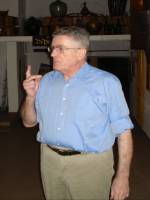
Snappy right off the go with bright fruit, a softly-rounded texture mid-palate
and fresh mineral-y flavours.
Erdener Treppchen Riesling
Feinherb, 2007 -
Again, ripe peaches, wild honey and soft, earthy undertones. Off-dry on the
palate with upfront fruit flavours - white peaches and citrus in a smooth
texture followed with a mouth-wateringly zesty finish.
Dr. Peter Pauly
Bernkasteler alte Badstube am Doctorberg Riesling Spätlese Feinherb,
2007 -
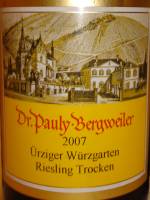
My favorite of the tasting showing aromas of apple-peel, stone fruits,
honey, fruit blossoms and loads of minerality. Off-dry on the palate with lemon
crème, apple, mixed tree fruits and mild herbal flavours. Clean and crisp in the
mouth with a softly-rounded texture a bright, spritzy finish and more creamy
fruit on the finish.
What
is feinherb? Click here
Bernkasteler alte Badstube
am Doctorberg Riesling Spätlese 2007 –
Tropical and musky, rich
aromas of peaches, wild honey with some herbal notes somewhat hidden by sulpher
after the wine went through a spontaneous fermentation needing the sulpher to
control it.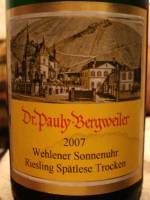
This is something I noticed in several wines tasted
throughout this trip. Time seems to benefit – allowing the sulpher to diminish
but consumers need to be aware of it. The palate was rich and sweet but with
balanced acidity.
Wehlener Sonnenuhr Riesling
Spätlese, 2007 –
Lovely honeydew melons, fresh mineral and white floral aromas with crisp Asian
pear aromas. A bit more than off-dry but not too sweet with lemony acidity,
honey and Asian pear return on the palate – rounded and delicious with a clean,
bright finish.
What’s available in
Canada?
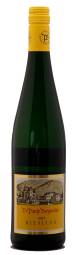
Selections of Dr. Pauly~Bergweiler wines are available in select regions across
Canada but vintages, prices and offerings may vary.
Dr. Pauly
Bergweiler Riesling, 2007
-
Fresh!
Aromas of lemon peel, honey blossoms loads of mineral notes and a fine seam of
petrol on the nose. Off-dry with lemon/lime flavours, tree fruit and steely
minerality. Tangy and crisp with a lingering zesty, mouth-watering finish.
Delicious!
($20+ BC Private wine stores, $13.95 LCBO)
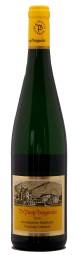
Bernkasteler
Badstube Riesling Kabinett, 2006
aromas echo the palate showing ripe peach/apricot flavours, chamomile tea with
honey, juicy citrus and the expected minerality. The palate is softly rounded,
it's off-dry but with bright acidity.
($28.99 BC)
For more information of
Weingut Dr. Pauly~Bergweiler - click
here
Moselland
 Romantic, no – a thriving,
important segment of German wine, yes.
Romantic, no – a thriving,
important segment of German wine, yes.
Moselland is the largest exporter of German wine-growing cooperatives.
They produce affordable well-constructed Rieslings for every-day drinking.
Before I
arrived in Germany I had reviewed two of their Rieslings already – easy-drinking
wines that are readily available in our market.
In fact, Moselland produces 20% of the wines in the Mosel – a jaw dropping 2.5
million cases per year.
Their Berkastel~Kues's bottling line was an eye-opener after the small
production wineries I’d been visiting on my tour. A new, massive, fully
automated machine puts through1000 cases per hour; bottled (any size), labeled,
corked (or Stelvin or Vino Lok), boxed and stacked on a palette before being
sent to a blue-tooth controlled warehouse.
Like I said, romantic – no, but you don’t
have to think about the production as you sip, just appreciate that it fills a
gap - allowing consumers around the world to enjoy German Riesling.
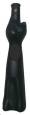
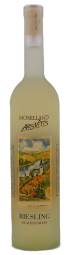
Perhaps the most recognized is the Moselland Cat Bottle
(above left) – in the shape of a tall
seated cat - this glass bottled started out as a “why not” and has become a
collector’s item. The first was black (perfect for Hallowe’en) then colours were
added in special releases including a pink one to support the fight against
breast cancer. Here we have the very attractive window series Rieslings - Ars
Vitis (right).
Read the Ars Vitis Review
Read the Review for
Moselland Piesporter Michelsberg Riesling
Want to know more about Moselland
- click here
More Rieslings from
Mosel~Saar~Ruwer
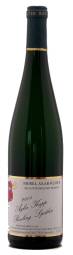
Ayler Kupp Bischofliche Riesling Spätlese, 2007
Juicy aromas of gala apples, honey, chamomile flowers and tea leaves. Being
a Spätlese it has more residual sugar but also a gorgeous weight on the palate.
Balanced, crisp yet weighty with lemon-lime, apricot, apple peel and creamed
honey with bright acidity and a long zesty finish.
($28.99 BCLDB Specialty)
Dr. Loosen "Dr. L" Riesling, 2006 -
Read Review here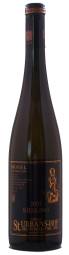
St. Urbans~Hoff Riesling, 2007
Loads of mineral and crisp lime-ade aromas with honey blossoms and a hint of tea
leaves. Off-dry on the palate but crisp and zingy flavours of lemon and white
grapefruit zest. Refreshing and easy-to-drink at only 10% alcohol.
($19.99 BCLDB)
And so, what to eat!?
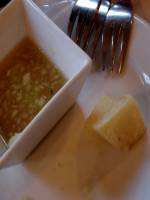
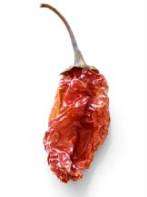
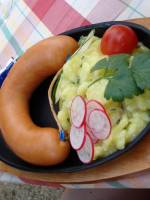
Hand
Kase - soft German cheese with onion vinaigrette, chile pepper, bratwurst &
potato salad
Options
for pairing food with Riesling….
I can sip German Riesling on its own, at any point in the day (hopefully after
noon though) because if it’s low alcohol and freshness, but certain types of
food do have an affinity for the queen of grapes.
Off-dry Rieslings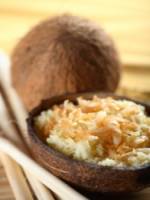
With our wide selection of Asian cuisine in Canada and especially in Vancouver
and Toronto Riesling makes perfect sense to drink. High alcohol and spice fight.
Together they burn, so it makes perfect sense to have something lower in alcohol
with spicy foods. Sweet also helps put out the fire of heat so small amounts of
residual sugar in a wine help with quell chile spices.
Also, quite often Asian dishes are both sweet and sour or sweet and hot which
means low alcohol, fruity wines with some sweetness and acidity (acidity to
balance the sour) are your best option. Ever notice how most Japanese, South
Asian or Chinese food focused restaurants you go into serve Riesling, or
aromatic, off-dry wines?
Because they make sense.
Pad Thai, sweet or spicy and creamy curries, samosas, wasabi and Japanese foods,
egg rolls or spicy spring rolls, spicy dumpling or potstickers, stir-fry’s made
with chicken, pork, tofu or fish.
Tom Yum soup...
What else?
Off-dry and dry Rieslings...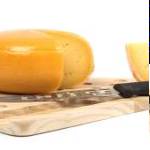
Cheese and cream
Chowders, seafood bisque and even French Onion Soup
Sweet lobster salad in a cream or mayonnaise dressing
Goat’s cheese, Gruyere, Gouda mild to aged, Edam, cream cheese and soft rind
cheeses.
White meat and fish
Baked ham with honey glaze, turkey and chicken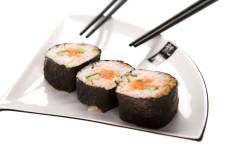
Schnitzel.
Shellfish, whitefish, poached fish with lemon or in creamy sauces.
Sushi (loves wasabi also)
Chilled smoked salmon, trout in butter or cream sauces.
German sausage (Bratwurst) and mustard
Vegetables and Tofu
Tofu – sweet, sour, spicy and Japanese agadashi tofu, stir fried or baked tofu
in spicy or soy glaze sauces.
Cauliflower in cream sauce
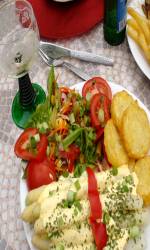
White asparagus with hollandaise (I ate enough of this in Germany to get me
through a year).
Potato salad
Glazed root veg like carrots or parsnips, sweet potato or sweet squash
Salads with sweet/tart vinaigrettes or creamy dressings
Scalloped potatoes made with cheese and cream.
Pizza’s or macaroni/pasta with cheese or white cream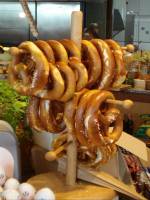 sauces only
German pretzels and mustard
 More
More
To read Germany part 1 - Rheingau
click
here
To read Germany part 2 - Rheinhessen, Nahe and the
Pfalz click here
To read "Understanding" German wine labels
click here
-end-